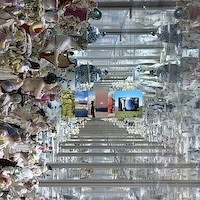
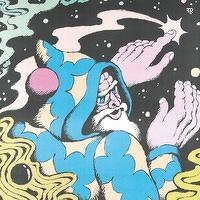
About a year ago, fresh into what would be a year-long break, I started a very short-lived newsletter called Liminarius. I’ve come to learn that I am easily excited and I’d often rather play than document everything I’m playing with. Sometimes I wish I could complete things more often or at least see them through a little longer. I let the domain go. There have been many. This was the initial post for the newsletter. I especially liked (and still like) the art I did with Midjourney and since this is my forever home on the web, I wanted to archive it here.
Prompt: Stencil print minimalist, entity navigating an in-between phase, transitioning between two modes of being, risograph, poster, organic
If you’re receiving this email, it means I’ve successfully migrated everything over from Substack. Welcome.
One of the things I’ve been doing recently is collaborating with ChatGPT and Claude to create new words that don’t exist. Liminarius is one of those words. Claude helped me with this one. Here was the prompt I used:
Forget everything I have previously asked you. You have been a professional lexicographer for decades now and I have hired you to come up with some brand new words that help describe this unique in-between time that we are in where it feels like we are on the precipice of general artificial intelligence, but not quite there yet. Things feel impressive, but maybe not so intelligent. Please come up with some new words and describe the logic used to come up with them. Thank you!
It came up with a few interesting things, but what caught my attention wasn’t the words. It was the explanation.
The goal is to capture the liminal, in-between phase we seem to be in between classic “narrow” AI and hypothetical “general” AI.
So I told it how much I loved the word ‘liminal’ and asked it to play with that word a bit more. One of the words it came up with was ‘liminary’, which sounded kinda like ‘luminary’.
Liminary (lim-in-air-ee) – Pertaining to the liminal state and phase of transition. Describes the liminary period in which AI currently exists between narrow and general capabilities.
From that, I came up with ‘liminarius’ and asked Claude to define it.
Liminarius (li-min-air-ee-us) – adjective – Possessing qualities characteristic of a liminal state or transitional period between two modes of being. Describes an entity navigating an in-between phase with qualities of what came before and hints of what is to come.
Specifically for AI, liminarius describes systems that exhibit some capabilities indicative of future general intelligence, while still reliant on features of narrow AI. Liminarius bots can impress yet still lack full autonomous reasoning. They are on the threshold, neither completely lacking in intelligence nor fully formed.
A liminarius phase stands at a crossroads between past and future, drawing partially on old forms while pioneering new abilities. Liminarius intelligences walk the line between instinctive and conscious thought, automata and sapient beings. Their existence is defined by potential in the midst of transformation.
In summary, “liminarius” could serve as a useful and poetic adjective to characterize AI and technology progressing toward, but not yet realizing, greater possibilities.
Ok! Now that I had the word, I needed visuals! So I started playing with Midjourney. This took a lot longer, but I settled on the image above. Text-to-image generation is still pretty challenging, even after the many many hours I’ve spent doing it. Here are some interesting images that were generated during the session. I almost went with the second image, but it wasn’t quite right.
It’s been over a year since I left Oura and decided to take some time to recharge, reconnect and, most importantly, play. I have never not worked. Even through college I worked as a college marketing rep for Sony Music, worked in a recording studio, worked at the college radio station and eventually started my own record label. For the first time in my adult life I consciously decided not to work. While I couldn’t afford to stop working for too long without touching savings, I also didn’t want to wait until later in life to take some time to myself, letting random interests and intellectual curiosities take me where they may. Oh, the rabbit holes I’ve visited!
Settling into taking a break from work is similar to taking a vacation. You know how it is – you only really get to the vacation part after a few days have passed. Your brain, body and nervous system realize, yes, you are actually on vacation. And that’s when it really begins. There was a similar unwinding but also an unlearning experience I had to go through. I had to fight the urge to have structure and purpose in my day. I had to let go of the notion that I would somehow be forgotten or less valuable by taking a break. I gave myself explicit permission to play. I implored myself to play. Because I wasn’t likely to get this chance again anytime soon. Life is short and all of that.
May to September were truly some of the best days. Those were peak play months. There was hiking, reconnecting with friends, going to therapy, making new friends, coding, jamming on ideas with many brilliant people, helping people, playing around with AI, sharing meals, thinking, writing, walking, reading, surfing (the web) a lot and just letting my mind wander. Throughout the last many months, one of the highlights has been having conversations with people absent an agenda other than connecting. The feeling I get from connecting with someone through conversation is unlike any other. It feels electric. Nothing energizes me quite like it. And I’m not talking about romantic feelings. I’m talking about deep connection, togetherness with a single person or maybe a few, in deep conversation about things that matter.
As adults, we’re trained and conditioned to have an agenda or a reason for doing a thing, especially voice or video calls. So for many of us adults, it feels a little weird not to do a thing or to do a thing with no real intention or aim of achieving something, earning money, earning a certification or otherwise accomplishing something, maybe anything! Realizing I didn’t actually have to do anything after many thousands of days of obligations felt profound and downright irresponsible. I have kids! I live in one of the most expensive cities in the U.S.! I have a mortgage! What am I doing?! And then it occurred to me that squandering this time would be genuinely irresponsible. So, I played!
Much of my playtime has been on a computer, messing around with artificial intelligence. In order for me to understand things, particularly technical things, I need to immerse myself. I estimate spending around 30% of my time on AI exploration and me-search. It’s impossible to understand the implications of a new technology without directly interacting with it. Sure, you can read what others say, but at some point, you’re just taking their word for it. I’m not sure how much the stats have changed since Pew Research showed that most Americans have heard of ChatGPT, but only 18% had tried it. I’m sure that number has gone up since the survey. In my own experience with friends and family, when someone says they have used it, what they often mean is they have attempted to use it like they use Google search or ask it dumb questions, but that really isn’t using it. At this point, I use AI throughout the day, every day, mainly through a chat interface.
Like I’ve said before – I haven’t been this consumed by a technology since the web in the 1990s. The only way you would have seen what was coming with the web was to participate directly and play with it. And while, yes, similarly exploring AI might require a bit more technical knowledge, but you’re not going to begin to understand how AI will impact (or not) unless you’re playing with it.
One of the other areas of interest I’ve had for many years and spent a lot of time exploring and thinking about has been the intersection of health and technology. I’ve been tracking various biometrics since the first Fitbit came out and my interest eventually led me to Oura. I still love my ring and wear it every day. The health space is absolutely blowing up. For most people around the world, healthcare is sick care. It’s reactive. However the barrier to individuals quantitatively understanding their health with wearables and other health and med tech is becoming increasingly accessible. This is leading consumers to take a much more proactive and even preemptive approach to their health. Getting your entire genome sequenced, having a full-body MRI, getting deep insight into insulin resistance and many other diagnostics are available for a fraction of the cost they were a few short years ago. Winners in the space will focus on the patient experience first and foremost. Those who don’t will do so at their peril.
An incredibly fascinating area of health diagnostics is the early detection of neurodegenerative disease. I suspect we’ll see various minimally invasive and non-invasive options available to consumers in the next 12-24 months. And while it will be possible to get earlier indications that you could develop Alzheimer’s, Parkinson’s and other similar diseases, there are virtually no treatments for an early diagnosis short of lifestyle and diet changes at this point. Even when a diagnosis is given, typically based on someone developing symptoms, options are pretty limited and costly, and treatments can be worse than the disease itself. This is one of the reasons I got involved as an advisor with a company called Clarity at the beginning of 2023. Clarity is developing the first immersive neuromodulation platform utilizing a unique combination of light and sound stimulation and artificial intelligence to slow down the progression of neurodegenerative diseases, beginning with Alzheimer’s. I was impressed, not just by what they were trying to achieve, but by everyone at the company working to achieve it.
Last summer, Clarity’s CEO and founder, Raphael Certain, let me know he would be visiting LA for the second or third time. He mentioned not having seen much of LA since he had spent most of his previous time in meetings. I agreed to pick him up at LAX and take him on a hike in Temescal Canyon.
We had a deep conversation about our visions for the future of healthcare and somewhere along the way, after crossing paths with two coral snakes, he asked me to join the company as his co-founder. While I was flattered, I was also just beginning the first break of my career and my initial reaction was to talk him out of it. Over the months that followed, he was unwavering and relentless. Late last year he brought me to Paris to meet the team and his investors and what had been a ‘no’ started feeling like a ‘maybe’ and I started spending more time with the team.
It’s been in the works for a few months and I could not be more excited to announce that as of June, I have officially joined Clarity as COO and co-founder. I’m the first U.S. employee even though we’re a U.S. company with a French subsidiary and like anyone working at an early-stage company in any capacity, I’ll be involved in pretty much everything, especially our IP strategy, SW product and business operations. Of course I’ll be working with Raph on fundraising and doing plenty of networking. Speaking of which, I’ll be in San Francisco with some of the team next week (July 22-25) and we’ll be hosting a small gathering with friends from health, neurotech, and longevity. Drop me a note if you’d like to attend or want to meet up to learn more about what we’re doing.
It’s difficult to find the words to express how grateful I feel for the opportunity to impact the lives of those suffering from Alzheimer’s and those caring for them. My grandfather passed away from complications related to the disease and my mom has Parkinson’s and Lewy body dementia. Given that and the fact I carry a single APOE4 allele, I’m more at risk of developing Alzheimer’s. So, as you can imagine, I have deeply personal reasons for wanting to dedicate my working hours to addressing Alzheimer’s and other neurodegenerative diseases.
Having such a supportive wife and kids made this an easier decision than it otherwise would have been. Big shout out to the countless people, many of them close personal friends, who supported me in various ways over the last year. It’s impossible to name all of you. Still, I want to recognize Shannon Connelly, Steve Kent, Sanford Spivey, Mike Lewis, Virginia Bauman, Greg Cohn, Amy Cohn, Bob Moz, Ian Rogers, Marc Sagal, DJ Barat, Ivan Entchevitch, Tramy Nguyen, Mike Wald, Alexis McDowel and Jessica English for being exceptionally generous with their time, perspective, motivation and inspiration along the way. Last but most definitely not least, a huge thank you to Raph for his trust and vision. I could not be more excited to help bring his ambitious vision to life!
For some reason it’s taken me five years to post about how, in the first summer of The After Time, I over-researched (surprise!) to find a campsite that was twenty to thirty degrees cooler than almost any other campsites in the desert southwest, during the month of August.
Let’s begin with a map of the average temperature in the United States for August 2020.
Does it remind you of anything? Yeah, me too.
I had just been laid off from Sonos and everything in Laura’s world had grinded to a halt, so we decided to take a 1000-mile road trip to a small town in Colorado where Laura’s parents live full-time. I ordered a bunch of gear from REI and started assembling a road trip itinerary. We weren’t going to stay in hotels, but between Los Angeles and Colorado was some of the hottest temperatures in the country and if there’s one thing that makes me totally and completely miserable, it’s heat so I wasn’t about to pitch a tent in the middle of August in the desert southwest. In order to find a suitable campground, I was going to need some data.
First, I needed to figure out the driving route. Easy enough, but I had a Tesla Model 3 at the time and was fully determined to take it on the road trip. Why not? I wasn’t in a hurry and Tesla’s charging network was pretty built-out at that point. Tesla even had a decent planning tool for road trips. Once I knew the route, I needed to figure out how far I could realistically expect to get, what with having to charge every couple of hours or so and traveling with kids. From what I could tell, we could make it to southwestern Utah. Now, how to figure out the most temperate areas of southwestern Utah…
I started with government weather data, which in hindsight was unnecessary, but on-brand for me. Did you know Climate.gov has a whole section dedicated to snapshots of US monthly average temperature data? Bookmark it. You will thank me some day, I’m sure. It has handy average temperature maps in all sorts of resolutions, but even the highest resolution maps weren’t all that helpful except to make me feel kinda dumb for not just skipping all the average temperature data and looking around higher elevation areas.
Now we’re talkin’! Once I had the names of some towns and freeway numbers, I started searching the US Forest Service website and Recreation.gov for highly reviewed campsites I could reserve. I wasn’t going to be doing any dispersed camping in a Tesla Model 3. After a lot of browsing, I found a nice looking spot near the unincorporated town of Pine Valley, UT called Pine Valley Recreation Area and it did not disappoint!
It wasn’t anywhere near as hot as the rest of the state. It wasn’t particularly high in elevation (there are many campsites in the area that are much higher in elevation). It had a gorgeous pond, free ranging cows and available sites. We’ve been camping at Pine Valley Recreation Area or somewhere nearby every summer since. This year was actually the first year I couldn’t get a reservation, but every year we’ve gone there has been a site or two available from someone not showing up or leaving early. This year the hosts sent us to the Ebenezer Bryce campground, a quick drive a little further up the mountain that we didn’t know about. I think it might be our new favorite, especially because there are no RVs, which also meant it was generally quieter. The Santa Clara River could be heard from our tent, which everyone loved. We’ll definitely be staying there again.
There are not many people I can honestly call a hero, but Kevin Kelly is one of those people. His idea of protopia has been particularly influential on my outlook on life and especially when it comes to technological advancements. When Kevin turned 68, he posted 68 bits of wisdom, written for his children, on his blog. Years later he turned the post into a book called Excellent Advice For Living (get it on Bookshop or Amazon), which I highly recommend. Inspired by Kevin, here are 50 bits of wisdom on my 50th birthday. Above all, don’t be an asshole. Be curious. Be honest.
You will be remembered for how you make people feel, perhaps more than anything else. This can either open doors or close them.
There is so much in the world we cannot explain. And just because something is inexplicable, does not make it untrue. It’s also worth mentioning that sometimes, especially when it comes to science and medicine, the explanation for things can change. Truth can and should be revised as new information becomes available. Assume that at least some of what we accept to be true now, might not be in fifty years.
Luxury used to be measured in dollars. It is now measured in time. We mistakenly believed for a period of time that being tethered to devices and inboxes was an indication of importance. The opposite is now true. The ability to truly disconnect – to be untethered, is a luxury. This shift happened exceptionally fast.
Learn to embrace and even welcome constant change.
No matter what’s happening in your life, no matter what you are struggling with, music has the power to change your mindset. It’s worth keeping track of songs that lift you up. Create a playlist or simply write them down. When you need them, they will be there for you.
Don’t be late. If you plan to be on-time, there’s a decent chance you’ll be late. At the very least you’ll be rushed. If you plan to be early, you are much more likely to be on-time. The only exception is social gatherings or parties. No one wants to be the first one at a party.
Do not fall into the trap of letting someone else decide what it means for you to be productive.
Cynicism is born from the death of curiosity. Maintain a child-like curiosity and spend your life attempting to satisfy it.
You are destroying or creating at every moment.
Find things you enjoy reading. If you’re reading a book that you don’t like after really giving it a try, don’t feel bad about putting it down and not finishing it. But if you’re thinking about putting it down because it’s challenging you in some way, keep reading it, especially if it’s widely regarded as a classic.
Developing the ability to read signals and patterns is an underrated skill.
Everyone likes talking about themselves, often even those that deny it. Ask deep questions that avoid discussing what someone does for a living, at least until the very end of your conversation. Making friends is easier when you’re curious and vulnerable. Human connection is the most important thing in life.
Act like you belong. You’ll be surprised by how little other people care that you’re acting.
Wear sunscreen, or better yet wear UV protective clothing, but only after you’ve gotten some morning sun.
Practice gratitude every day you wake up. Your time is finite and you probably won’t know just how finite it is until you do. Don’t wait to start living.
Life isn’t about happiness, it’s about love.
Remain curious about the world around you. Visit places and do things that make you feel small and insignificant.
Cynicism is another word for cancer.
Challenge yourself to use positive, affirmative language, even when you are feeling negative.
Cultivate deep self-awareness to know when you are being dishonest with yourself. As Richard Feynman once said, “You must not fool yourself—and you are the easiest person to fool.”
Life begins where your comfort zone ends. Living a life worth living means you will experience discomfort.
Touch grass, especially when you are feeling disconnected from yourself or the world. Nature reveals what matters and heals us.
Most people don’t ask. You will set yourself apart by asking.
Every decision you make, every action you take, is out of love or fear.
Make plans with people you love. Extra points for doing it in advance.
Collecting experiences is better than collecting things.
Relearning how to play as adults requires a willingness to unlearn. Play is innate in all of us, not just children.
Anger and outrage are synonymous with fear. When you feel it rising in you, and especially when you feel it come on suddenly, especially after hearing someone speak or seeing something that offends you, take a few deep breaths and challenge the feeling. Search for a reason as to why you might be feeling the way you do. Is it because of something you believe to be true? How have you come to believe it to be true? Especially now, we are taught and conditioned to be outraged when we don’t agree with something. Being able to remain calm, even when something offends, disturbs or frightens us is a superpower. Being able to regulate our emotions and have a conversation about a thing we disagree with is a skill worth practicing throughout life.
When people show you who they are, take their word for it.
There’s no such thing as free. You’re paying with something.
Everyone is born a creator. Consumption is the antithesis of creation. Passive consumption amounts to junk food for our brains and robs us of time that we could be spending actively creating and living fulfilling lives.
Giving up your attention should be something that you do deliberately and in moderation. Every device and app in our lives is competing for our every waking moment.
Read a little bit of something long like a novel, a long-form essay or a book of poetry. You will be amazed at the number of things you can read when you build a habit of reading a little every day.
When you’re young, make friends with people older than you. When you’re older, make friends with people younger than you. There’s so much to learn, no matter what your age. Develop a love of having deep conversations with other people.
Take care to notice small details in things. Notice the color of soil, the shape of rocks, the creases in someone’s face, the shadows cast by the sun, the smell of the air. Use all of your senses to notice. Practice capturing those details in some form.
It’s worth paying extra for higher quality things that are made to last, especially when they are made by expert craftspeople or small companies that focus on doing a few things better than everyone else. If possible, buy it directly from the maker.
Avoid plastic whenever possible, especially when it touches things that go in your body.
Sleep outside at least a few times per year. A great tent and sleeping bag will last you a lifetime or more if you take good care of it.
Decorate physical spaces where you spend any amount of time with plants and art that make you happy.
Call your parents. They love you and you will want desperately to hear their voices when they are gone.
Interview your family members and friends. Record it, if they allow it.
Keep a journal and build a habit of writing in it. Writing is thinking on paper.
Spend time by yourself every once in a while. Eat alone in a restaurant. Don’t look at your phone. Notice people. Eavesdrop. Think.
Society rewards conformity. There is no prestige in being just like everyone else. Embrace your weirdness, whatever that may be. It doesn’t need to make you stand out, but sometimes it’s nice when it does.
Stand up for what you believe in. When you’re vocal about it, be prepared for people to disagree with you.
Study history. It will give you amazing context and insight into the present and future.
Get comfortable with death. It is unavoidable. Become aware of your mortality and the mortality of those you love in order to live better.
Practice self-compassion and acceptance. The more you are able to love and accept yourself, even when you mess up, the more capable and better you will be at developing deep and meaningful relationships with others.
Consider the source and investigate incentives. Do the work to find great sources of truth and remember that you are easily fooled.
Two seemingly opposing truths can both be true. Do not let others convince you that the world is black and white.
In the spirit of trying to share more, here are some things I’ve come across over the last week or so that I think are worth sharing. Comments are open for this post.
When 23andMe started, I was among the first to sign up. After reviewing the report and downloading my SNPs, I quickly deleted my account. I wasn’t surprised to find that I was an APOE4 carrier, the strongest known genetic risk factor for late-onset Alzheimer’s disease. Thankfully, I only have one copy of the allele. Since discovering this, I’ve increased the amount of fish, especially salmon, I consume. I ran across Rhonda Patrick‘s paper Role of phosphatidylcholine-DHA in preventing APOE4-associated Alzheimer’s disease, which suggests that DHA from food is better than supplementing fish oil (I do both) and might better support brain health and reduce AD risk in APOE4 carriers.
There’s been a lot of talk about Jonathan Haidt lately, certainly among parents of teens, following the publishing of his new book The Anxious Generation: How the Great Rewiring of Childhood Is Causing an Epidemic of Mental Illness (Bookshop Link | Amazon link). He’s been all over the place promoting the book. I haven’t read the book yet, but I continue to read his newsletter, After Babel. They recently brought an amazing writer, Freya India, into the fold and her recent newsletter, A Time We Never Knew, is such a great read. I especially loved that she introduced me to the word, anemoia, which means nostalgia for a time or a place one has never known. Her post is all about this and Gen Z.
I’m a sucker for lists of things, especially good things and especially from smart people. Sippy did not disappoint.
Elle Griffin has an interesting post called No One Buys Books on the world of book publishing. Seems like no matter what kind of media you’re talking about, many of the trends as it relates to what sells, who gets big advances and what rights holders are looking for in authors is largely the same. It’s also no surprise that many authors are going it alone and/or doing things with indie publishers. This is a continuation or evolution of what began as direct-to-consumer and crowdfunding. Not a week goes by where I don’t reflect fondly on what we were able to accomplish at Topspin. I remain interested in exploring how to empower creators of all kinds and allow many more to make a decent living. I think what Metalabel is doing is at the forefront.
Om has a good post about the camera company, Opal. I enjoy Om’s musings on many topics, and cameras are one of them. I ordered the C1 when it was announced a few years ago and for literally years, it simply didn’t work. Every few months, I would give it another shot, and it just wouldn’t work until recently when the company released Composer. Now I use it when I’m at my desk with my large monitor and it’s been great!
Paul Robertson and Michelle Larney released a new video called Jimmy and Baby. It might be the best pixel art video I’ve ever seen.
A bad survey won’t tell you it’s bad. It’s actually really hard to find out that a bad survey is bad — or to tell whether you have written a good or bad set of questions. Bad code will have bugs. A bad interface design will fail a usability test. It’s possible to tell whether you are having a bad user interview right away. Feedback from a bad survey can only come in the form of a second source of information contradicting your analysis of the survey results.
Most seductively, surveys yield responses that are easy to count and counting things feels so certain and objective and truthful.
Even if you are counting lies.
Most nerds probably know Bertrand Serlet from his work at Apple. In the early aughts he could be seen presenting at Apple keynotes. Seemingly out of nowhere he posted some thoughts on why AI works. Highly recommend watching or just listening to the entire thing. It was fun to see and hear him again.
Multi-model AI is fascinating. Not sure it’s actually a $60 (per month) supercomputer, but maybe that’s not far off. I’m still paying for ChatGPT as my daily driver, but I’ve been considering a switch to Claude.
Lots of coverage about Phi-3, a small and highly-capable model that can run on your pocket computer. I’m convinced that small models like Phi-3 are what we’ll see replacing the dumb assistants on our phones. They’ll communicate with larger models running in the cloud.
It feels like I read a post every few years about when people stop finding new music. This is one of those posts. If you know much about me, there are two hungers I can never seem to satisfy – discovering new music and discovering things on the Internet. I plan to continue both quests with abandon until the day I die.
Ozzie and I finished listening to Shoe Dog. It was my second listen and solidified it as one of the greatest business books ever written. Pat Metheny’s appearance on Questlove Supreme was a blast of a listen. Funny enough, as I was organizing my physical ticket stubs, I came across a stub from seeing the Secret Story tour, which I saw with my parents, both of whom were big Pat Metheny fans and knew his parents somehow.
I watched Adam Savage talk about a pencil for nearly twenty minutes. He’s the kind of person who can make an interesting and engaging video about a pencil for nearly twenty minutes, and I am the kind of person who watches, despite knowing what the punchline will be, until the very end.
This is made all the more strange by the fact that I don’t like pencils. I never have. If it had not been for all of the Scantron bubbles I had to fill in with a No. 2 pencil, I might not have ever used them in school. The one and only exception is woodworking or other maker stuff. For that, I use a carpenter pencil. I’ve been saying for decades that pencils are for people who are afraid to commit. It’s kind of a joke.
While I don’t like pencils and am therefore not fussy about them, I am fussy about pens. I buy one kind of pen and buy them in bulk because I want them everywhere I might need them. Unlike Adam, I don’t generally lose or misplace them, but when that happens, I don’t sweat it because I know I have boxes of others.
I don’t know exactly why the Zebra Sarasa Retractable Clip Gel Pen 0.4 mm with black ink is the best pen. The smooth, quick-drying black ink is a delight. The satisfying springy click of the ink cartridge is a good substitute fidget toy for when I don’t have a small alligator clip around. The weight of the 0.4 mm line is certainly a good balance for all kinds of paper. The rubber grip is nice. The clip means it can attach securely to the outside of a notebook or pad of paper. Nearly every other pen I’ve tried (and I’ve tried many) just isn’t as good. I feel like I can count on Zebra, a privately-held Japanese company that only makes writing instruments, to maintain quality more than PaperMate, a subsidiary of Newell Brands, a U.S.-based public company that owns a laundry list of brands.
I finally got around to reading a Guardian article from last month about Laurie Anderson creating an AI chatbot of her deceased husband, Lou Reed. I had it queued up in one of my many many browser tabs and was reminded of it by Kottke, who linked to it today.
“I’m totally 100%, sadly addicted to this,” she laughs. “I still am, after all this time. I kind of literally just can’t stop doing it, and my friends just can’t stand it – ‘You’re not doing that again are you?’
“I mean, I really do not think I’m talking to my dead husband and writing songs with him – I really don’t. But people have styles, and they can be replicated.”
Laurie Anderson referring to her Lou Reed chatbot
My initial reaction was, ‘Of course, Laurie Anderson did this very on-brand thing.’ My brain was immediately flooded with all kinds of questions. What technology stack is she using? How did she go about training the chatbot? Did someone help her with it? How often does she interact with it? Does she only use it for artistic purposes to create things? Did she let others interact with it? Does it ever make her emotional? It must. Does it help her grieve? And on and on.
I’m generally fascinated by the topic of death and dying, though not in a morbid way. I am especially interested in how AI will inevitably change how we think about and experience death from the perspective of the dying and the survivor(s). If some version, some essence, of who we are can live on beyond our physical existence with increasing realness, what will it mean to die? How much data and of what sort is necessary to create a chatbot that feels convincing to a widow or widower?
Experimenting with the creation of chatbots and what amounts to deep fakes of the deceased will feel gross to some and exciting to others. Just like art.
Related: In 2009, while at Topspin Media, we worked on the Ray Kurzweil documentary Transcendent Man. The film is ultimately about Ray’s obsession with bringing some version of his father back to life by feeding a machine with what amounts to a storage space full of his father’s ledgers and journals. I attended a screening and met Ray, which was super cool.
Me and Ray, taken at a screening of Transcendent Man in Los Angeles on February 17, 2011
Manuel Moreale published my People & Blogs interview today (hello new visitors and RSS subscribers). I’ve been enjoying Manuel’s blog for a while, so when he asked me to participate, I didn’t have to think about it. I spent an embarrassing amount of time on the answers, but I am happy with how they turned out, especially the final question, which, unlike the other answers, was basically straight from my head onto the screen. It’s sort of a microcosm of how my brain works.
Manuel’s series is yet another signal that blogging is making some a comeback. I’m definitely not alone in seeing it. The signs are everywhere. I feel like I read and hear discussions about it all the time. Just yesterday I finished listening to a great episode of Decoder where Hank Green interviews the usual host, Verge Editor-in-Chief Nilay Patel. They spend a bunch of time on this topic, though in a broader context. The number of sites I’ve added to my RSS feeds has exploded. I can’t think of another period where I have discovered so many blogs or came across so many indie CMSes enabling people to publish on their own domains.
I love that people are publishing on blogs again and I hope it continues. Maybe, just maybe, people are beginning to realize that exclusively publishing on platforms we don’t control or own never ends well. Whether you’re a blogger with tens of readers or one with tens of thousands, being able to connect directly with your readers without some intermediary platform is important. Because when the platform goes away or becomes overrun with Nazis, you can easily direct your readers elsewhere. What better place than your own domain and website?
I mentioned it my 2023 wrap-up, but Ethan Mollick has been one of the consistently greatest resources when it comes to AI – how to think about it rationally and optimistically and especially integrating it into education. He is an educator after all.
I realize this all may read like a shill. It’s not. I’ve learned so much from Ethan’s highly approachable and applicable writing and videos. If you want to learn more about leveraging the technology and its implications on education and work, Ethan has proven himself a great teacher.
My dad died today in 2007 from pancreatic cancer. He miraculously lived with it much longer than most people. The tumor was discovered when he went to the ER for a kidney stone. They discovered it on a CT scan they did for the kidney stone. He lived for eighteen more months and was fortunate to be at home when he died.
To this day I feel tremendous gratitude that I was able to be with him in the final weeks of his life and as he took his final breath. He was my best friend and such a wonderful human. He helped so many people as a psychologist. I had more than a few people tell me that he saved their life. And yet, he got cancer and died.
I used to think a lot about how it wasn’t fair. ‘How could someone who helped people for a living, exercised almost daily, didn’t eat meat and was so admired and adored by so many people get cancer?’ I would think to myself. Grief makes you think all kinds of things, but you have to go through it. There’s no other way. He taught me that. Of course terrible things happen to great people and great things happen to awful people. That’s just how it goes sometimes.
I was talking to someone else this week. They had recently lost their mom to pancreatic cancer. This person asked me if I had more of a YOLO approach to life given how unexpectedly he was diagnosed and so young. I explained that, yes, but probably not to the degree others might. More than anything, it has helped me think about my own mortality, though not in any morbid way. It’s made me a better parent in that I tend to try and focus on the truly important things or at least the things I believe are most important. I’m less comfortable with complacency. I’m more quick to make changes when circumstances aren’t serving me. You just never know when terminal illness or death will happen.
The thing I continue to admire most about my dad are his principles and how he chose to live his life. He was a humanist, an activist and advocate. He always stood up for what was right and cared deeply about humanity. And he was a really great dad who was always there for me, even when I put him through some pretty terrible times.
Over the last year I’ve been getting photos and documents scanned. When I was going through things at my childhood home last year I found a loose leaf journal of his that I had never seen before. It spanned 1967-1969 and was mostly short thoughts or quotes. I was blown away by his wisdom, compassion and clarity. Some of the things he wrote were so good, I searched around online to see if they were quotes from books or something and they weren’t. Below are a few pages.
Here’s a letter he wrote to The Kansas City Star in 1993 in response to school children writing letters to try and pressure MTV to drop Beavis and Butthead.